If you are searching for 100 dollar in Indian currency, the value depends on the current USD to INR exchange rate. As of September 23, 2026, a live exchange-rate lookup gives approximately 1 US dollar = 95.7205 Indian rupees, which means 100 US dollars is approximately ₹9,572.05. Exchange rates move throughout the day, so the exact amount can be different when you actually exchange, send, receive, or spend the money.

This article explains how to convert $100 into Indian rupees, how the USD to INR calculation works, why different services may show different amounts, and what can affect the amount you actually receive. It also covers practical examples for travelers, international workers, freelancers, students, online shoppers, businesses, and people sending money between the United States and India.
Table of Contents
How Much Is 100 Dollars in Indian Rupees?
Using the exchange rate of 1 USD = 95.7205 INR, the calculation is:
100 USD × 95.7205 = 9,572.05 INR
Therefore, $100 is approximately ₹9,572.05 at that rate.
The result represents a currency conversion based on the quoted rate. It does not necessarily mean that a bank, money transfer service, exchange office, card network, or other provider will give you exactly ₹9,572.05 for $100.
For example, a provider may apply an exchange-rate markup, transaction fee, service charge, or other cost. As a result, the final amount received can be lower than a simple conversion using the mid-market or reference rate.
Current USD to INR figures can also change during the day. On September 23, 2026, market data showed USD/INR trading around the mid-95-rupee range, with different sources displaying slightly different rates depending on timing and methodology.
For this reason, a live currency converter is more useful when you need the amount for an actual transaction.
What Does USD to INR Mean?
USD to INR describes the conversion of United States dollars into Indian rupees.
USD is the international currency code for the United States dollar.
INR is the international currency code for the Indian rupee.
When you see USD/INR, the first currency is the base currency and the second currency is the quote currency. A rate of 95.7205 means that one US dollar is equivalent to approximately 95.7205 Indian rupees at the quoted rate.
The direction of the conversion is important.
If you are converting dollars into rupees, you multiply the dollar amount by the USD to INR exchange rate.
For example:
50 USD × 95.7205 = 4,786.025 INR
100 USD × 95.7205 = 9,572.05 INR
200 USD × 95.7205 = 19,144.10 INR
If you are converting rupees back into dollars, the calculation works in the opposite direction. You divide the INR amount by the USD to INR rate.
For example, using the same illustrative rate:
9,572.05 INR ÷ 95.7205 = 100 USD
This distinction helps prevent one of the most common currency conversion mistakes, which is using the correct exchange rate in the wrong direction.
How to Calculate 100 Dollars in Indian Currency
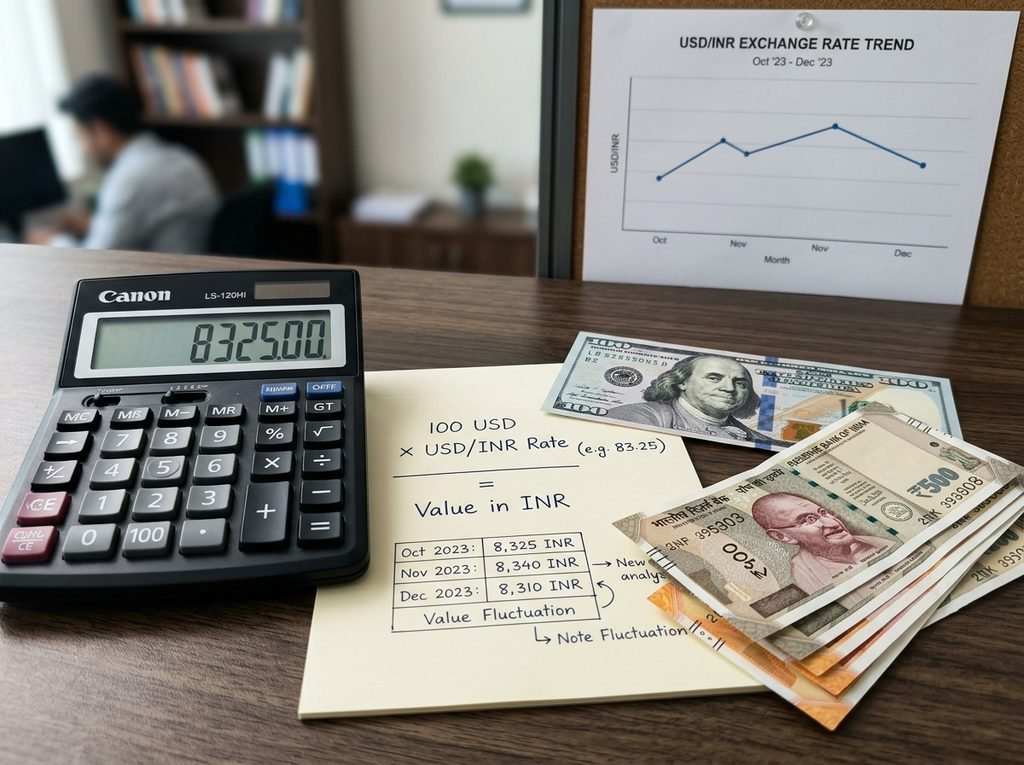
The basic formula is straightforward:
Dollar amount × USD to INR exchange rate = Indian rupee amount
For $100, if the exchange rate is 95.7205:
100 × 95.7205 = ₹9,572.05
The calculation requires only two pieces of information:
The amount in US dollars
The current USD to INR exchange rate
The important part is obtaining an appropriate exchange rate. If you are simply researching the approximate value of $100, a current reference or mid-market rate can provide a useful estimate.
If you are actually sending money or exchanging cash, however, you should check the rate and fees offered by the provider handling the transaction.
100 USD to INR Conversion Examples
The value of other dollar amounts can be calculated using the same method. Using 1 USD = 95.7205 INR as the example rate, the approximate conversions are:
| US Dollar Amount | Approximate Indian Rupees |
|---|---|
| $1 | ₹95.72 |
| $5 | ₹478.60 |
| $10 | ₹957.21 |
| $20 | ₹1,914.41 |
| $25 | ₹2,393.01 |
| $50 | ₹4,786.03 |
| $75 | ₹7,179.04 |
| $100 | ₹9,572.05 |
| $150 | ₹14,358.08 |
| $200 | ₹19,144.10 |
| $500 | ₹47,860.25 |
| $1,000 | ₹95,720.50 |
These figures are mathematical examples based on the stated rate, not guaranteed transaction amounts. Since currency markets change, the same dollar amount can produce a different rupee result later.
Why Does the Value of 100 Dollars Change?
The value of $100 in Indian rupees changes because exchange rates are not permanently fixed.
The USD/INR exchange rate reflects conditions in the foreign exchange market and can be affected by many economic and financial factors. These can include interest-rate expectations, inflation, economic growth, international capital flows, oil prices, trade conditions, central bank activity, and changes in global demand for currencies.
For example, India imports significant amounts of crude oil, so movements in global oil prices can influence the country’s foreign-exchange environment. Market reporting on September 23, 2026, also linked recent rupee movements to crude oil prices and broader Asian currency movements.
The Indian rupee can therefore strengthen or weaken against the US dollar even when the amount being converted has not changed.
If the rate moves from 95.72 INR per USD to 96.50 INR per USD, $100 would be worth:
100 × 96.50 = ₹9,650
If the rate instead moves to 94.50 INR per USD:
100 × 94.50 = ₹9,450
The dollar amount remains $100 in both examples, but the rupee value changes because the exchange rate changes.
Why Different Websites Show Different USD to INR Rates
It is normal to see slightly different USD to INR rates across websites, banks, money transfer providers, and financial platforms.
One reason is timing. Foreign exchange markets operate continuously across international trading sessions, and different services may update their displayed rates at different times.
Another reason is the type of rate being displayed.
A mid-market rate is generally a reference point representing the middle between buying and selling prices in the wholesale or broader currency market. Currency services may use this rate for informational conversion purposes.
A bank or money transfer company may use its own customer exchange rate. That rate can include a markup over the underlying market rate.
For example, a website may show a reference rate of 95.72 INR per USD, while a provider actually offers a customer a somewhat different rate.
Fees can create another difference. Some providers show a competitive exchange rate but charge a separate transfer fee. Others may include some of their costs within the exchange rate itself.
This is why comparing only the displayed exchange rate does not always tell you how much money the recipient will ultimately receive.
Is 100 Dollars Really Equal to ₹9,572.05?
At the quoted rate used in this article, $100 converts mathematically to approximately ₹9,572.05.
However, this should not be interpreted as a guaranteed amount that you will receive in a real transaction.
The actual amount can depend on:
The exchange rate at the time of the transaction
The bank or provider’s exchange-rate markup
Transfer fees
Card or payment processing fees
Cash exchange charges
The payment method
The destination and source countries
The time the transaction is processed
For example, if a provider applies a less favorable customer rate of 94.50 INR per USD, the conversion before any separate fee would be:
100 × 94.50 = ₹9,450
That is ₹122.05 less than the amount calculated at 95.7205 INR per USD.
This simple example shows why the quoted market rate and the final transaction amount should be treated as two different things.
How Fees Affect 100 Dollar Currency Conversion
Suppose you want to convert $100 and a provider charges a hypothetical $3 transaction fee.
If the fee is deducted from the dollars before conversion, the amount converted would be:
$100 − $3 = $97
Using the illustrative exchange rate of 95.7205:
$97 × 95.7205 = ₹9,285.89
This is only an example to demonstrate the effect of fees. Real providers may structure their charges differently.
A provider might instead charge the fee separately, deduct it from the recipient’s amount, or include costs through the exchange rate.
When comparing currency services, consider the final amount delivered rather than looking at the headline exchange rate alone.
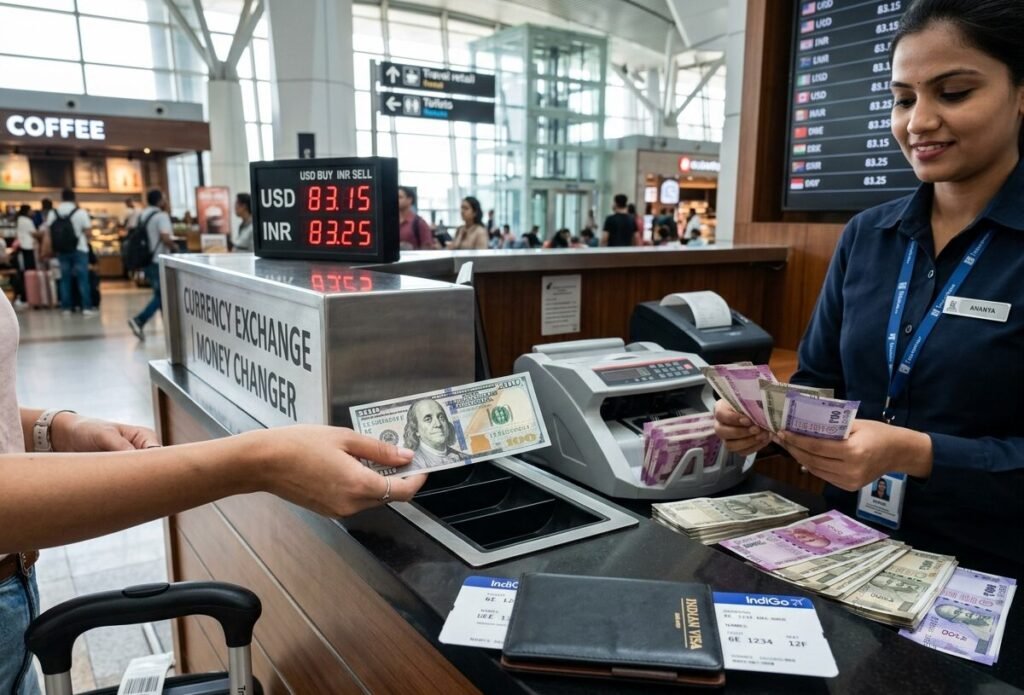
100 Dollars in Indian Rupees for Travelers
Travelers may search for 100 dollar in Indian currency before visiting India to estimate their spending budget.
At approximately ₹9,572.05, $100 represents a useful reference amount for planning purposes at the rate used here.
However, travelers should remember that the amount they receive when exchanging physical cash can differ from an online reference rate.
Cash exchange services may have their own buying and selling rates. Airports and tourist-oriented exchange locations can also use different pricing structures from banks or specialist currency providers.
If you use a US-issued card in India, the amount charged to your account can also depend on the card network’s conversion process and the card issuer’s foreign transaction policies.
Therefore, the online value of $100 should be treated as a reference rather than a guaranteed travel spending amount.
100 Dollars in Indian Rupees for Freelancers
Freelancers working with US clients may receive payments in dollars while their expenses are in Indian rupees.
For example, a freelancer receiving $100 could estimate the rupee value by multiplying the payment by the current USD to INR rate.
At 95.7205:
$100 × 95.7205 = ₹9,572.05
But the amount ultimately available to the freelancer may differ because payment platforms, banks, payment processors, or international transfer services can apply their own exchange rates and fees.
Freelancers should therefore distinguish between the gross payment in USD and the final INR amount credited to their account.
The same principle applies to remote workers, international contractors, creators, online service providers, and businesses receiving overseas payments.
100 Dollars in Indian Rupees for Online Purchases
Currency conversion is also relevant when an Indian customer sees a product or service priced in US dollars.
Suppose an online service costs $100.
Using the illustrative rate of 95.7205 INR per dollar:
$100 = ₹9,572.05
This is a conversion estimate before considering taxes, payment processing charges, foreign transaction fees, shipping costs, customs charges, or other applicable costs.
The final amount charged to a customer may therefore be higher than the simple currency conversion.
For international purchases, it is important to check the final checkout amount rather than relying only on the USD to INR conversion.
100 Dollars in Indian Rupees for Students
Students may also need USD to INR calculations when paying for international courses, software subscriptions, application fees, educational resources, or other expenses priced in US dollars.
If a course costs $100, a rate of 95.7205 INR per USD gives an estimated value of ₹9,572.05.
If the exchange rate changes before the payment is processed, the rupee cost can change.
For larger education-related payments, even a relatively small exchange-rate movement can make a noticeable difference. This is why students and families comparing international costs should check the current rate when making an actual payment.
How to Use an Online USD to INR Calculator
A currency calculator simplifies the conversion process.
To calculate $100 in Indian rupees, enter:
Amount: 100
From currency: USD
To currency: INR
The calculator then applies the selected exchange rate.
For an informational conversion, the result can provide a quick estimate of the rupee value.
A tool such as the ExpoVault currency calculator can be useful when you want to compare different amounts without manually performing each multiplication.
For example, instead of calculating $25, $50, $100, $250, and $500 separately, you can enter each amount into a currency converter and compare the results.
The most important thing is to check the timestamp or rate source when accuracy matters because exchange rates can change.
What Is the Difference Between an Exchange Rate and the Amount You Receive?
An exchange rate tells you how much one currency is worth relative to another.
The amount you receive is the result after the provider’s pricing and applicable costs are considered.
For example, suppose the reference rate is:
1 USD = ₹95.72
A customer might expect:
$100 = ₹9,572
But if a provider uses an effective rate of ₹94.80 per dollar, the conversion becomes:
$100 × 94.80 = ₹9,480
The difference is ₹92.
If there is also a separate service fee, the final amount may be lower still.
This is particularly important for international money transfers. A seemingly small difference in the exchange rate can become more significant as the transaction amount increases.
What Can Make USD to INR Conversion More Expensive?
Several costs can affect the final amount received.
The first is the exchange-rate spread. This is the difference between the provider’s buying and selling prices.
The second is a direct transaction fee. Some services charge a fixed fee for sending or exchanging money.
The third is a percentage-based fee. This cost increases as the transaction amount increases.
Another possible cost is a foreign transaction or card fee when using a payment card internationally.
There may also be intermediary charges in certain international transfer arrangements.
Because pricing structures vary, the best way to understand the cost of a transaction is to compare the amount you send with the amount the recipient actually receives.
Common Mistakes When Converting 100 Dollars to INR
One common mistake is using an old exchange rate. A rate found in an article, screenshot, or search result from a previous day may no longer represent the current market.
Another mistake is confusing USD to INR with INR to USD.
USD to INR tells you how many rupees correspond to one dollar.
INR to USD tells you how many dollars correspond to one rupee.
A third mistake is assuming that the mid-market rate is automatically the rate offered by your bank or transfer provider.
Another mistake is ignoring fees.
People may also round the rate too early. For a quick estimate, rounding can be useful, but for larger transactions, using a more precise rate can reduce calculation differences.
Finally, some users treat a currency conversion as a fixed value. Exchange rates are variable, so a conversion result should always be associated with the rate and time used.
Quick Reference for 100 Dollars in Indian Currency
Using the rate of 1 USD = 95.7205 INR:
100 USD = ₹9,572.05
Rounded to the nearest rupee:
100 USD ≈ ₹9,572
Rounded to the nearest hundred rupees:
100 USD ≈ ₹9,600
The rounded figures are useful for quick budgeting, while ₹9,572.05 is the more precise mathematical result based on the stated exchange rate.
For an actual transaction, use the current rate available at the time of payment or exchange.
Does the USD to INR Rate Stay the Same All Day?
No. The USD to INR exchange rate can move during the day.
On September 23, 2026, market sources showed USD/INR around the 95.6 to 95.7 range, illustrating that the quoted rate can vary slightly between data sources and timestamps.
Recent market reporting also showed the rupee moving modestly against the dollar as traders considered factors including crude oil prices and central bank activity.
This means that an answer to the question “How much is 100 dollars in Indian currency?” is time-sensitive.
For educational purposes, a rate can be used to demonstrate the calculation. For an actual transaction, the current rate should be checked immediately before completing the transaction.
Why the Dollar and Rupee Move Against Each Other
The USD/INR exchange rate reflects the relative value of the two currencies.
If the rupee weakens against the dollar, fewer rupees are needed for each dollar. For example, a move from 95 INR per USD to 96 INR per USD means $100 has a higher rupee value.
If the rupee strengthens, the opposite occurs.
A range of economic and financial factors can influence the exchange rate. These include interest-rate expectations, inflation, trade flows, energy prices, foreign investment flows, global risk sentiment, and central bank operations.
This does not mean that any single factor determines the exchange rate by itself. Currency markets respond to changing expectations and information from many parts of the global economy.
How to Get a More Accurate Conversion
If you only want to know the approximate value of $100, multiplying by a current reference USD to INR rate is sufficient.
If you need the amount for a real transaction, take a few additional steps:
Check the current exchange rate.
Confirm whether the displayed rate is a mid-market, bank, cash, or customer rate.
Check transaction and transfer fees.
Review the final amount before confirming the transaction.
Compare the final amount received rather than only the advertised rate.
These steps can help you understand the difference between a simple currency conversion and an actual financial transaction.
FAQs
How much is 100 dollars in Indian currency?
At an exchange rate of 1 USD = 95.7205 INR, $100 is approximately ₹9,572.05. The actual amount can change as exchange rates move and may differ because of provider fees and exchange-rate markups.
What is the current USD to INR exchange rate?
The rate used for this article is 1 USD = 95.7205 INR based on a live exchange-rate lookup on September 23, 2026. Other providers may show slightly different rates because rates change and providers can use different pricing sources and timestamps.
How do I convert 100 USD to INR?
Multiply the dollar amount by the USD to INR exchange rate. For example, if the rate is 95.7205, multiply 100 by 95.7205 to get ₹9,572.05.
Can 100 dollars be worth more or less than ₹9,572?
Yes. If the USD to INR exchange rate changes, the rupee value of $100 changes as well. Fees and provider exchange-rate markups can also affect the final amount received.
Why does my bank show a different USD to INR rate?
Banks and financial providers may use customer exchange rates that differ from a mid-market reference rate. Their rate may include a spread or markup, and additional transaction fees may also apply.
Is $100 a lot of money in Indian rupees?
The converted value is approximately ₹9,572 at the rate used in this article. Whether that amount is significant depends on the purpose, location, expenses, and individual circumstances. Currency conversion alone does not determine purchasing power.
What is the formula for converting USD to INR?
The formula is: USD amount × USD to INR exchange rate = INR amount. For $100 at 95.7205 INR per USD, the calculation is 100 × 95.7205 = ₹9,572.05.
Can the USD to INR rate change during the day?
Yes. Foreign exchange rates can change as market conditions, trading activity, economic information, and other factors change. A current rate should be checked when an exact transaction amount is important.
Does the $100 conversion include transfer fees?
No. A simple USD to INR calculation does not automatically include transfer fees, bank charges, card fees, or exchange-rate markups. Those costs depend on the provider and transaction method.
Is the $100 to INR figure guaranteed?
No. The calculated amount is based on the stated exchange rate. Actual conversion proceeds may differ because exchange rates change and providers can apply their own rates and fees.
Conclusion
The value of 100 dollars in Indian currency depends on the USD to INR exchange rate at the time of conversion. Using 1 USD = 95.7205 INR, $100 equals approximately ₹9,572.05.
The calculation is simple: multiply the dollar amount by the USD to INR rate. However, the amount you actually receive can differ because of exchange-rate movements, provider spreads, transaction fees, and other charges.
For quick research, a currency calculator provides a convenient estimate. For an actual payment, transfer, or currency exchange, check the current rate and the provider’s final transaction amount before completing the transaction.
Exchange rates are time-sensitive, so figures in this article should be treated as a reference for the stated date and rate rather than a guaranteed future value. The examples are for informational and educational purposes.