
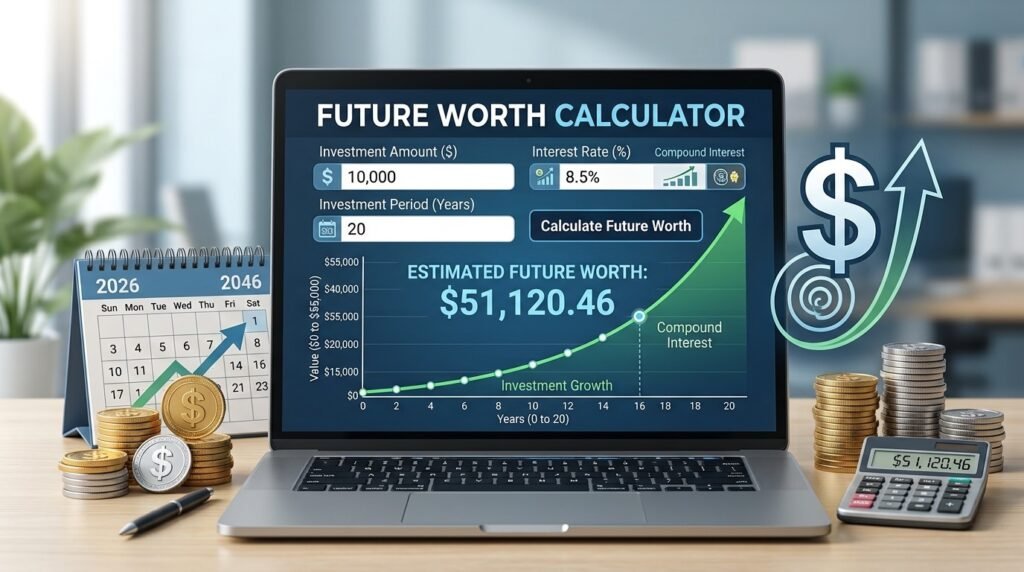
Money invested today can grow significantly over time but calculating its future value can be difficult. A future worth calculator estimates how much your savings or investment may become using the interest rate investment period and regular contributions. It makes planning for retirement education a home or other financial goals easier and clearer.
What Is a Future Worth Calculator
A future worth calculator is a financial tool that estimates how much a present amount of money may be worth on a selected future date. It uses variables such as the current investment, annual interest rate number of years and compounding frequency to calculate the projected future amount.
Future worth is also commonly known as future value. Both terms describe the value that money invested today could reach after it earns interest or investment returns over time. The result is an estimate rather than a guaranteed amount because actual returns, taxes inflation and fees can change.
Why Future Worth Matters
Understanding future worth helps you connect your current financial decisions with your long-term goals. Instead of simply knowing that you have saved a certain amount you can estimate how that money may grow if it remains invested.
This calculation can also show the importance of starting early. An investment with a longer growth period generally has more opportunities to earn compound returns. Even a modest initial amount may grow substantially when it earns returns over several years.
How Does a Future Worth Calculator Work?
A future worth calculator applies a mathematical formula to the information entered by the user. At a minimum, it needs the present amount, expected return rate, and investment period. A more advanced calculator may also include regular deposits compounding frequency inflation fees, and taxes.
After processing these details the tool displays an estimated future balance. Some calculators may also separate the original principal additional contributions and total interest earned, making the result easier to understand.
Information Required for the Calculation
The initial investment is the amount of money you currently have available to save or invest. It may be a one-time deposit in a savings account certificate of deposit retirement account, mutual fund or another financial product.
You must also enter an expected annual interest rate and a time period. If regular contributions are included you may need to specify the deposit amount contribution frequency and whether deposits are made at the beginning or end of each period.
Understanding the Interest Rate
The interest rate represents the estimated percentage your money may earn annually. For a savings account you may use the stated annual percentage yield. For market-based investments you may enter a reasonable estimated average return based on your plan and risk tolerance.
It is generally better to test multiple rates instead of relying on one optimistic figure. Comparing conservative moderate and higher-return scenarios can give you a more balanced understanding of the possible outcomes.
Future Worth Formula Explained
The standard formula for calculating future worth with compound interest is: FV=PV(1+r/n)nt
In this formula FV represents future value, PV is present value, r is the annual interest rate written as a decimal is the number of compounding periods per years and is the number of years.
Meaning of Each Formula Component
Present value is the amount invested today. For example if you deposit $5,000 into an investment account the present value is $5,000. The annual interest rate must be converted into decimal form, so a rate of 6% becomes 0.06.
The compounding frequency tells the formula how often interest is calculated and added to the balance. Annual compounding uses one period per year monthly compounding uses twelve, and daily compounding usually uses 365 periods.
A Basic Calculation Example
Suppose you invest $10,000 for ten years at an annual return of 6%, compounded annually. The calculation would be: FV=10,000(1+0.06)10
The estimated future worth would be approximately $17,908. The investment gains about $7,908 during this period assuming the rate remains constant and no money is added or withdrawn.
Simple Interest and Compound Interest
Simple interest is calculated only on the original principal. If you invest $10,000 at 5% simple interest the investment earns $500 each year. Over ten years the total interest would be $5,000, producing a final balance of $15,000.
Compound interest is calculated on the principal and previously earned interest. This means the balance used for each new interest calculation can increase over time. As a result compound interest usually produces a higher future worth than simple interest when the other variables are equal.
Why Compounding Can Accelerate Growth
Compounding allows your returns to generate additional returns. During the early years, the difference may appear small. However the effect can become much more noticeable as the investment period increases.
Time is therefore one of the most influential variables in a compound interest calculation. Starting earlier can sometimes have a greater effect than making larger deposits later because early contributions have more time to compound. A future worth calculator shows how time can affect investment growth.
Simple Interest Formula
The future worth formula for simple interest is: FV=PV(1+rt)
If $4,000 earns 4% simple interest for five years its future worth would be $4,800. This formula is helpful for certain loans and financial agreements but most long-term savings and investment calculations use compound interest.
How Compounding Frequency Changes Future Worth
Compounding frequency refers to how often earned interest is added to the account balance. Common frequencies include annually semiannually quarterly monthly and daily.
When interest is compounded more frequently the money begins earning interest on previous interest sooner. This may increase the final value, although the difference between monthly and daily compounding is often smaller than the difference between annual and monthly compounding.
Common Compounding Options
Annual compounding adds interest once per year. Quarterly compounding adds it four times while monthly compounding adds interest twelve times. Daily compounding generally adds interest every day.
You should choose the frequency that matches the account or investment being calculated. Using monthly compounding for a product that compounds annually would overstate the estimated future worth.
Comparing Different Frequencies
Imagine that $10,000 is invested for ten years at a nominal annual rate of 5%. With annual compounding, its future worth would be about $16,289. With monthly compounding it would reach approximately $16,470.
The difference is meaningful but not enormous. The investment period return rate, and contribution amount usually have a much greater impact than small changes in compounding frequency.
How Regular Contributions Affect Future Worth
Many people do not invest only one lump sum. They add money weekly monthly or annually. A useful future worth calculator should therefore allow users to include recurring contributions.
Regular deposits can significantly increase the future balance because each contribution has an opportunity to earn returns. Earlier deposits generally grow more because they remain invested for a longer period.
Future Worth of Regular Deposits
The future value of recurring deposits made at the end of each period can be calculated using the following formula: FV=PMT×i(1+i)N−1
Here PMT is the contribution made during each period i is the return rate per period, and N is the total number of contribution periods. When an initial investment is also included its future value is calculated separately and then added to the value of the contributions.
Beginning and End Contributions
A contribution made at the beginning of a period has more time to earn a return than one made at the end. Calculators sometimes describe these options as an annuity due and an ordinary annuity.
Select the option that most accurately reflects your actual deposit schedule. If your calculator does not offer this choice check its instructions to determine when it assumes contributions are made.
How to Use a Future Worth Calculator
Begin by entering the amount you currently have available. If you are starting without a lump sum and plan to build savings through regular deposits enter zero as the initial balance if the calculator allows it.
Next enter the expected annual return, number of years, compounding frequency, and recurring contribution. Review every field carefully before calculating because a small input mistake can substantially change a long-term projection. The future worth calculator result depends on the information you enter.
Enter the Present Amount
Use your actual current balance when evaluating an existing savings or investment account. For a new plan enter the amount you expect to deposit initially.
Avoid entering borrowed money unless your calculation specifically accounts for borrowing costs. The interest paid on debt may reduce or eliminate the benefit of investing the borrowed funds.
Select a Realistic Return
Choose a rate that is appropriate for the type of account or investment. A guaranteed savings product and a stock-based portfolio do not have the same expected return or level of risk.
For investments with variable returns, consider running several calculations. A lower-return scenario may represent difficult market conditions, while a moderate scenario may serve as your main planning estimate.
Choose the Investment Period
Enter the number of years you expect the money to remain invested. The calculator assumes the balance can continue growing throughout this entire period without unplanned withdrawals.
If you expect to use part of the money earlier, run a separate calculation for each major withdrawal date. This produces a more realistic estimate than assuming the complete balance remains invested.
Add Recurring Deposits
Enter the amount you plan to contribute regularly and select the appropriate frequency. Monthly contributions are common because many people schedule deposits shortly after receiving their salary.
Use an amount you can maintain consistently. An unrealistic monthly deposit can make the calculator’s final result look impressive without providing a practical financial plan.
Review the Estimated Result
After selecting calculate, examine the future balance and any available breakdown. The result may include the starting principal, total contributions, estimated earnings, and final future worth.
Do not focus only on the final number. The breakdown helps you understand whether the projected growth comes mainly from your deposits or from returns generated by the investment.
Future Worth Calculation Examples
Examples make it easier to understand how time, interest, and contributions work together. The following scenarios are simplified illustrations and do not represent guaranteed investment performance.
Actual results may vary because interest rates can change, market returns fluctuate, and fees or taxes may apply. Use examples as educational guides rather than personal investment recommendations.
Growth of a Lump-Sum Investment
Assume you invest $15,000 for fifteen years and earn an average annual return of 7%, compounded annually. The future worth would be approximately $41,385.
Your original contribution remains $15,000 while estimated growth contributes about $26,385. This example demonstrates how a long investment period can allow compound returns to become a major part of the final balance.
Growth With Monthly Contributions
Suppose you begin with $5,000 and contribute $300 each month for twenty years. If the account earns an average annual return of 6%, compounded monthly, the projected balance would be approximately $150,000.
The exact result may vary slightly depending on whether contributions are made at the beginning or end of each month. Nevertheless the example shows that consistent deposits can be just as important as the starting balance.
Comparing Early and Delayed Investing
Consider one person who invests $200 per month for thirty years and another who invests the same monthly amount for twenty years. At the same return rate, the person who begins earlier may accumulate substantially more than the person who delays.
The difference comes from both additional contributions and extra compounding time. A future worth calculator makes this effect visible and may help users understand the financial cost of postponing a savings plan.
How to Understand Your Calculator Result
The displayed future worth is a projection based on the assumptions you entered. It does not promise that an investment will reach that exact amount.
A reliable interpretation should consider the initial investment, total deposits, estimated returns, inflation fees, and taxes. Viewing these components separately provides a clearer picture than looking at the ending balance alone.
Principal and Contributions
The principal is the amount initially invested. Regular contributions are the additional amounts deposited throughout the selected period.
Adding the principal and all recurring contributions shows how much money you personally placed into the plan. Comparing that figure with the final balance reveals how much growth the calculator attributes to interest or investment returns.
Estimated Interest or Earnings
Estimated earnings are the difference between the projected final balance and the total money contributed. In a compound growth calculation, earnings can generate additional earnings over time.
A large earnings figure may be possible over a long period, but it usually depends on maintaining the assumed return. Variable investments may perform above or below the calculator’s estimate.
Nominal and Real Future Worth
Nominal future worth is the future amount before adjusting for inflation. It tells you how many dollars the account may contain but not what those dollars may be able to purchase.
Real future worth adjusts the projection for inflation. This figure provides a better estimate of future purchasing power and can be particularly helpful for retirement and other long-term financial goals.
Future Worth Versus Present Worth
Future worth estimates what current money could become after earning returns. Present worth works in the opposite direction by determining what a future amount is worth today.
For example, future worth can estimate how much a $20,000 investment may grow over ten years. Present worth can estimate how much you need to invest now to reach a desired amount ten years from today.
When to Use Future Worth
Use future worth when you know how much money you currently have and want to estimate its potential value later. It is useful for savings plans, retirement projections, business investments, and education funds.
It is also helpful when comparing different rates or time periods. By changing one variable at a time, you can see which factor has the greatest effect on your projected outcome.
When to Use Present Worth
Use present worth when you already have a future target. For example, if you want $100,000 in fifteen years, a present worth calculation can estimate the amount you would need today at an assumed return.
Present worth is also used to compare future cash flows, evaluate investments, and estimate the current value of future payments. The calculation uses a discount rate rather than a growth rate.
Future Worth Versus Future Value
Future worth and future value are generally used to describe the same financial concept. Both terms refer to the value of a current sum or cash flow at a future date after applying an interest or return rate.
“Future value” is more common in personal finance and investment education. “Future worth” is often used in engineering economics, project analysis, and comparisons of financial alternatives.
Why Different Terms Are Used
Different industries may prefer different terminology even when they use nearly identical formulas. Engineering economics may use future worth to compare the cash flows of projects at the end of an analysis period.
Personal finance websites often use future value because the phrase is familiar to investors and savers. When selecting a calculator examine its inputs and formula instead of relying only on its name.
How Inflation Changes Future Purchasing Power
Inflation is the general increase in prices over time. As prices rise, the purchasing power of each dollar may decline. Therefore, a future balance of $100,000 may not purchase the same amount of goods and services that $100,000 can purchase today.
A basic future worth calculator may display only the nominal future amount. For long-term planning, it is helpful to calculate an inflation-adjusted value as well.
Inflation-Adjusted Future Worth
A simplified real return can be estimated using the investment return and inflation rate. A more precise formula is: Real Return=1+Inflation Rate1+Nominal Return−1
If an investment earns 7% while inflation averages 3%, the real return is approximately 3.88%, not exactly 4%. Using the real return in a calculator can provide a better estimate of future purchasing power.
Why Inflation Assumptions Matter
A small change in the assumed inflation rate can have a major effect over several decades. This is especially relevant for retirement plans because future living expenses may be significantly higher.
Because inflation is uncertain, calculate more than one scenario. Testing moderate and higher inflation assumptions can help you understand the range of purchasing-power outcomes.
How Taxes and Fees Affect Future Worth
Investment fees reduce the amount of money that remains available to compound. Even a small annual fee may create a noticeable difference over a long period.
Taxes may also reduce your net return, depending on the investment, account type, holding period, and applicable tax rules. A calculator that ignores these costs may overestimate your spendable future balance.
Understanding Investment Fees
Common costs include management fees, fund expense ratios, trading costs advisory charges, and account administration fees. Some charges are deducted directly, while others are reflected in investment performance.
When possible, enter a return rate after estimated fees. For example, if you expect a gross return of 7% and annual expenses of 1%, a simplified calculation might use a 6% net return.
Considering Taxes
Interest, dividends, and investment gains may be taxed differently. Tax-advantaged accounts may delay or reduce certain taxes, while taxable accounts may create annual tax obligations.
Tax rules vary by location and individual situation. A future worth calculator can provide a general estimate, but a qualified tax professional can help you understand the potential tax effect on your specific plan.
Common Uses of a Future Worth Calculator
A future worth calculator can support many personal and business decisions. It translates abstract percentages into estimated monetary outcomes, making financial alternatives easier to compare.
The calculator is most helpful when its assumptions are realistic and regularly updated. It should support financial decision-making rather than replace a complete plan.
Retirement Planning
Retirement savers can use the tool to estimate how their current balance and monthly contributions may grow. They can then compare the result with their estimated retirement needs.
If the projected amount is below the target, users can test a higher contribution, longer time period, or different asset allocation. Any decision involving additional investment risk should be evaluated carefully.
Education Savings
Parents and students can estimate how much an education fund may be worth when tuition payments begin. Including regular contributions can show whether the current savings approach is likely to reach the desired target.
Because education costs may rise faster than general inflation, users should consider a separate education-cost inflation assumption. The future account balance should be compared with projected expenses rather than current tuition alone.
Home Deposit Planning
Someone saving for a home can calculate how monthly deposits and savings interest may build a future down payment. A shorter time period usually makes regular contributions more important than compound growth.
The projection can also help establish a practical monthly savings target. However, property prices may change during the saving period, so the required deposit should be reviewed regularly.
Business and Project Analysis
Businesses can use future worth calculations to compare projects equipment purchases, and cash flow alternatives. Converting amounts to a common future date can make options with different payment timings easier to evaluate.
Business calculations may also include maintenance expenses, operating income, salvage value, and a required rate of return. More complex decisions may require financial modeling beyond a basic online calculator.
Benefits of Using a Future Worth Calculator
The main benefit is speed. Calculating compound growth manually can be time-consuming, particularly when regular contributions and monthly compounding are involved.
The tool also allows users to test several scenarios quickly. Changing the return, deposit amount, or investment period helps demonstrate how each assumption affects the projected result.
Better Goal Setting
A calculator converts a general goal such as save more for retirement into a measurable projection. You can estimate the monthly contribution needed to move closer to a specific target.
This does not guarantee success, but it provides a practical starting point. Reviewing the calculation periodically can help you adjust the plan when your income, expenses, goals, or investment performance changes.
Easier Financial Comparisons
The calculator can compare two savings accounts investment strategies, or deposit schedules. For a useful comparison, keep all variables equal except the one you want to evaluate.
Do not select an option only because it displays the largest future value. Higher expected returns often involve higher risk, and account accessibility, fees, taxes, and guarantees may also matter.
Limitations of Future Worth Calculations
A future worth calculator relies on assumptions. If the entered return is unrealistic the result will also be unrealistic. This is sometimes described as “garbage in, garbage out.
Most simple calculators assume a constant return, consistent deposits, and uninterrupted compounding. Real financial situations are usually less predictable.
Investment Returns Can Change
Market investments do not normally earn the same percentage every year. They may rise strongly during one period and lose value during another.
An average return simplifies these changes into one rate. It can be helpful for planning, but it does not show the timing of gains and losses or sequence-of-returns risk.
Personal Circumstances Can Change
Income loss, emergencies medical expenses and changing priorities may interrupt contributions or require withdrawals. Either event can reduce the actual future balance.
Build flexibility into your plan and maintain an appropriate emergency fund. This can reduce the need to withdraw long-term investments at an unfavorable time.
Common Future Worth Calculator Mistakes
One common mistake is entering a percentage in the wrong format. Some calculators expect users to type 6 for 6%, while others may require 0.06. Read the field label or instructions carefully.
Another frequent error is mixing annual and monthly values. The return rate compounding period, and contribution frequency must be handled consistently for the result to be accurate.
Using an Unrealistic Return Rate
Selecting an extremely high return can produce an attractive future value but an unreliable plan. Historical performance does not guarantee similar results in the future.
Use evidence-based assumptions that match the investment type and risk level. Running conservative and moderate scenarios is usually more informative than depending entirely on an optimistic estimate.
Ignoring Fees and Inflation
A large nominal future balance can create a false sense of security if its purchasing power is much lower. Inflation should be considered whenever the goal is several years away.
Fees can also reduce growth because the money used to pay them no longer earns future returns. Use net returns or a calculator with dedicated fee and inflation fields when possible.
Confusing Compounding With Contribution Frequency
Monthly contributions do not automatically mean interest is compounded monthly. The two schedules can be different.
Check the financial product’s terms to identify its actual compounding method. Then enter contributions according to your intended deposit schedule.
Tips for More Reliable Future Worth Estimates
Start with accurate current information, including your true balance and an affordable contribution amount. Confirm the interest or return assumption and select the correct compounding frequency.
Create multiple projections rather than relying on one result. A range of outcomes makes uncertainty visible and supports more cautious decision-making.
Compare Different Scenarios
A conservative scenario can use a lower return and higher inflation rate. A moderate scenario can reflect your most reasonable expectations, while an optimistic scenario can illustrate the outcome if conditions are favorable.
The moderate estimate may serve as your central plan, but the conservative result can reveal whether your goal remains achievable under weaker conditions.
Update Your Calculation Regularly
Recalculate future worth when your balance contribution amount, investment strategy or timeline changes. An annual review is useful for many long-term plans.
Compare the projected balance with the actual account balance. If results are consistently below expectations, revise the return assumption or consider whether your contributions need adjustment.
Focus on Controllable Factors
You cannot control future market returns inflation, or interest-rate changes. However, you may have some control over your contribution amount, investment costs, savings consistency, and time in the market.
Improving controllable factors can make a financial plan more dependable. Even small, sustainable increases in recurring deposits may create a meaningful difference over a long period.
Latest Update in Future Worth Calculators
Modern financial calculators increasingly provide interactive charts, inflation adjustments, recurring deposits, and separate displays for principal and investment growth. These features help users understand not only the final result but also how the balance develops over time.
Some advanced tools also support changing contribution amounts, variable return assumptions, taxes, and fees. These additions can produce more realistic projections than calculators that assume one constant rate for the entire period.
What Users Should Look For
A useful calculator should clearly explain its assumptions formulas and contribution timing. It should also separate the total amount deposited from estimated earnings.
Privacy is another important consideration. A basic future worth calculation should not require sensitive banking information, account passwords, or identity documents. Users should avoid tools requesting unnecessary personal or financial credentials.
Future Worth Calculator Reviews and User Expectations
Users generally prefer calculators that are fast, mobile-friendly, and easy to understand. Clear input labels are important because financial terms such as compounding frequency and present value may be unfamiliar to beginners.
A detailed results section can improve the user experience. Charts, calculation summaries, and side-by-side scenarios help users understand how different decisions may influence their future savings.
Signs of a Helpful Calculator
A trustworthy calculator explains whether deposits occur at the beginning or end of each period. It also states whether the displayed result includes inflation, fees, or taxes.
The tool should not present estimates as guaranteed returns. Transparent limitations and educational explanations are signs that the calculator is designed to support responsible financial planning.
Frequently Asked Questions
What Does Future Worth Mean?
Future worth is the estimated value that a present amount of money may reach on a future date. It accounts for interest or investment returns earned during the selected period.
The term is often used interchangeably with future value. It may apply to one initial deposit, a series of recurring payments, or a combination of both.
Is Future Worth the Same as Compound Interest?
Future worth is the final projected amount, while compound interest is one of the methods used to calculate its growth. Compound interest includes earnings on both the original principal and previously earned interest.
A future worth calculation may also use simple interest in situations where interest is earned only on the original amount. The appropriate method depends on the financial product being evaluated.
Can a Future Worth Calculator Predict Investment Returns?
No calculator can predict investment performance with certainty. It produces an estimate based on the return rate and other assumptions entered by the user.
Market conditions, fees, taxes inflation, and contribution changes can cause actual results to differ. Calculations should therefore be treated as planning scenarios rather than guarantees.
What Interest Rate Should I Enter?
For a fixed-rate savings product, use the current stated rate and verify how frequently it compounds. Remember that the rate could change when a fixed term expires.
For a market-based investment, use a cautious long-term assumption appropriate for the asset type. It is helpful to compare several possible rates rather than depending on one estimate.
How Often Should Interest Be Compounded?
Select the frequency used by the actual account or investment. Common choices include annually, quarterly, monthly, and daily.
More frequent compounding can slightly increase future worth when the nominal rate is the same. However the return rate investment period and contribution amount usually have a larger effect.
Does the Calculator Include Inflation?
A basic future worth calculator may not automatically include inflation. It may display only the nominal future amount.
If the calculator has an inflation field, use it to estimate future purchasing power. Otherwise, calculate the result using an estimated real return or use a separate inflation adjustment tool.
Can I Include Monthly Contributions?
Yes, an advanced future worth calculator normally allows monthly or annual deposits. Enter the contribution amount and select its correct frequency.
Check whether the tool assumes contributions are made at the beginning or end of each period. Beginning-of-period deposits generally produce a slightly higher result because they have more time to grow.
How Can I Increase My Future Worth?
You may be able to increase future worth by contributing more, starting earlier, reducing fees, and keeping your money invested longer. A higher return may also increase the result but higher expected returns often come with additional risk.
Focus first on changes you can maintain safely and consistently. Avoid taking unsuitable investment risks simply to produce a larger projected number.
Conclusion
A future worth calculator provides a practical way to estimate how savings and investments may grow over time. By entering your present balance expected return, investment period compounding frequency, and regular contributions you can create a useful projection for financial planning.
The final result should always be viewed as an estimate rather than a promise. For more reliable planning use realistic assumptions compare multiple scenarios include inflation and fees and update the calculation regularly. When used carefully a future worth calculator can help you set clearer goals and make more informed financial decisions.